
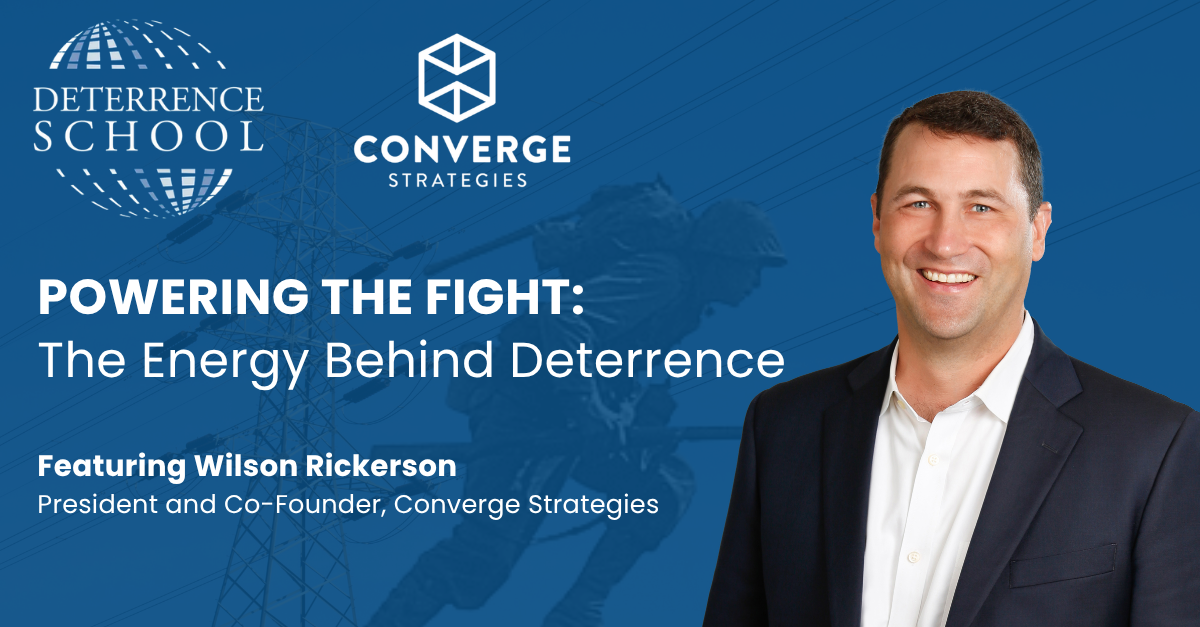
Wilson Rickerson, Converge Strategies, joined Paul Schleckman on Deterrence School, produced by Missouri State University’s School of Defense & Strategic Studies.
Deterrence by Resilience. Electricity underpins national defense. We have to treat the grid as strategic infrastructure and recognize it is the backbone of our military, our economy, and the defense industrial base.
The Path Forward. Wilson outlines how the lessons learned from Powering the Fight: Lessons from the Grid at War can inform today’s conversations on supercharging the defense industrial base, prioritizing policy consistency, and encouraging strategic investments in our interregional transmission.
Highlights from the conversation include:
Powering the Fight. The U.S. experienced electricity shortfalls in every major conflict of the last century. If the U.S. had to fight a major war today, the power grid would immediately be tapped to deliver uninterrupted electricity for critical missions at domestic military installations, while simultaneously supporting wartime manufacturing
Shifting Dependence on the U.S. Power Grid. Modern military missions are globally networked and domestically anchored. Our installations are increasingly dependent on a vulnerable and aging U.S. power grid and on other civilian utilities, water, wastewater, and communications that are also electricity dependent.
The Fence Line isn’t the Perimeter. Military installations, defense communities, and defense manufacturing rely almost entirely on the grid. Roughly 70% of military personnel and their families live outside of the installation and rely on the same civilian infrastructure that powers our installations.
The Grid is the Front Line in Conflict. Ukraine proved that energy infrastructure is a first-strike target, the capture of Venezuela’s Nicolás Maduro showed the implications of targeted blackouts, and China is scaling its grid investment at a scale and consistency the U.S. has yet to match.