
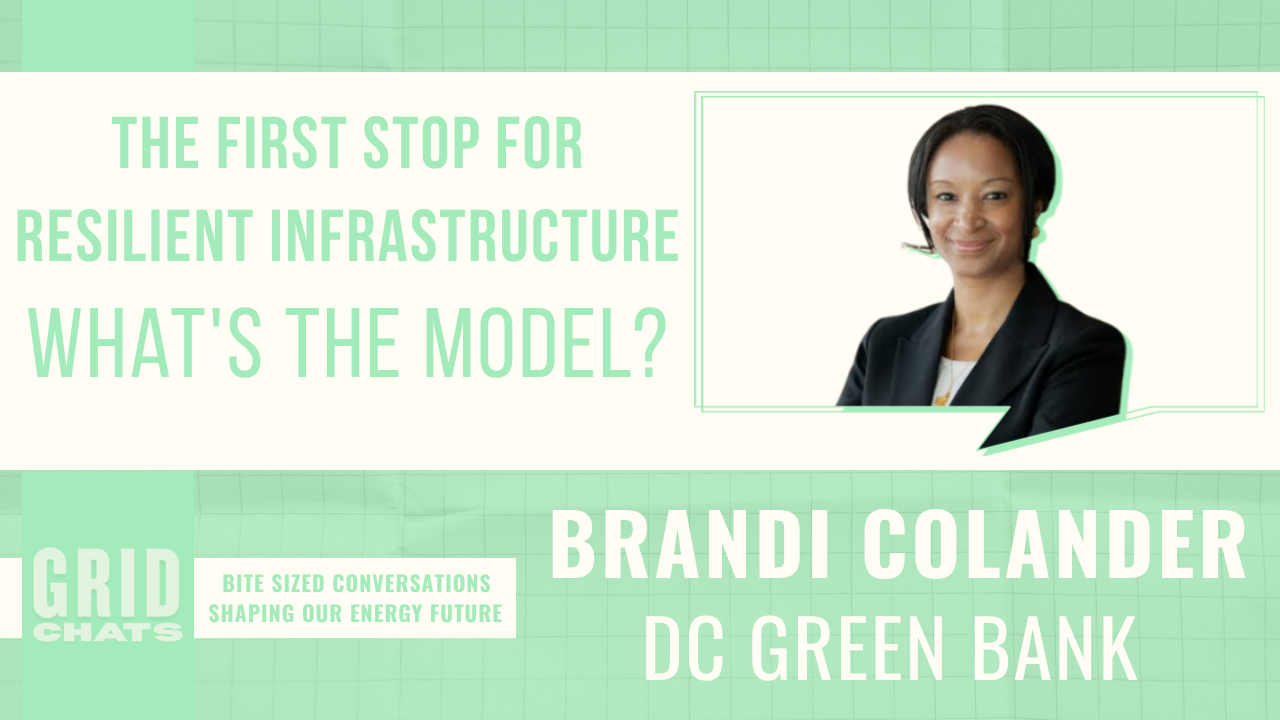
“We’re not a conventional finance institution. We are really thinking about how to build a capital stack that mitigates risk and allows for new technologies, new projects to come to life.”
That’s Brandi Colander, CEO of DC Green Bank and former Deputy Assistant Secretary at the Department of the Interior and Deputy General Counsel at the White House Council on Environmental Quality, on the latest episode of Grid Chats. A green bank isn’t a bank in the conventional sense, and it isn’t a grant program either. Brandi chats with host Michael Wu about what it means to be a mission-based institution built to de-risk investment in resilient infrastructure across the community it serves.
What’s Happening. DC Green Bank operates as a one-stop shop: technical assistance, help structuring the financing so a deal actually pencils, and capital to launch pioneering technologies when the timing is right. The range in scale is wide, from a church replacing an inefficient boiler to “The Geneva,” a $465 million PACE deal converting an underused DC office building into 532 residential units.
Why It Matters. Conventional lenders are risk-averse by design. That means fewer projects get built, and the ones that do cost more to finance. Green banks take a longer view, underwriting for the bigger picture rather than the immediate return, which is what makes new technology and unproven projects fundable in the first place. It’s a hub with many different spokes, plugged into what’s happening from legislative, policy, financial, and legal perspectives, all at once, to build infrastructure that wouldn’t otherwise pencil out.
What’s Next. Brandi traces her own interest back to graduate school at Yale, watching a professor help stand up Connecticut’s green bank as an early proof of concept. Green banks exist to carry risk long enough for a project to prove itself, clearing the way for the next one, each project building toward a more equitable, resilient, and sustainable community. That model has since grown into a national network of similar institutions. Scaling further means each green bank proving its own model sufficient to become self-sustaining, just as DC Green Bank has.