Why It Matters
Military installations must be sufficiently powered to meet national security objectives, and it is unclear who has the authority and responsibility to ensure the security and resilience of critical infrastructure. As a result, military installations currently face a governance gap. Defense energy needs are not systematically incorporated into state energy policy, despite states increasingly shaping the grid conditions on which installations depend.
The Way Ahead
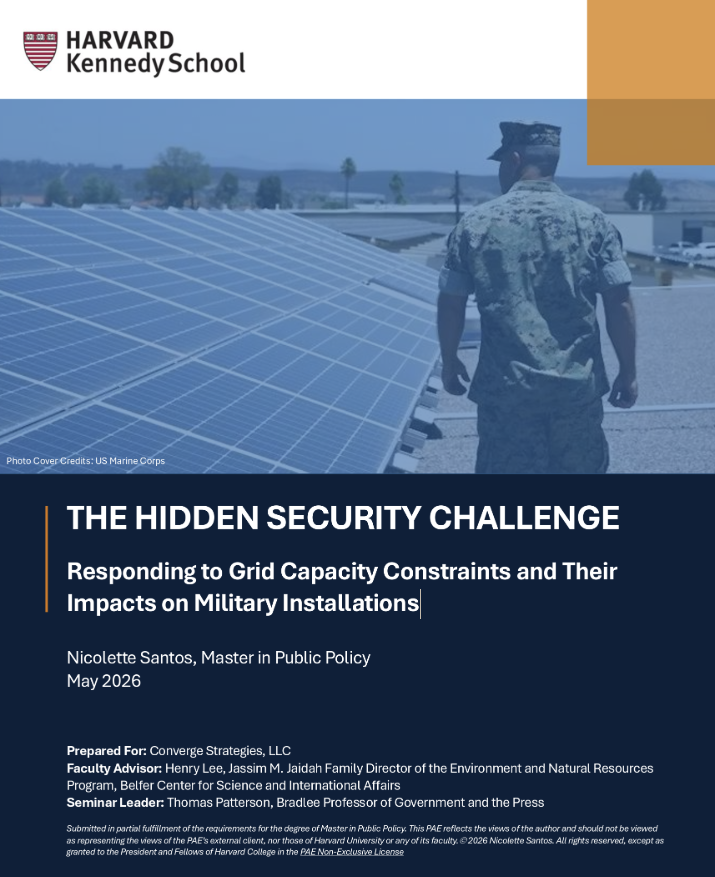
“The Hidden Security Challenge,” prepared for Converge Strategies by Nicolette Santos (Harvard Kennedy School, Master in Public Policy, April 2026), examines current grid challenges and their impact on defense infrastructure, what barriers the Department of War (DoW) faces when engaging in state policymaking, and how stakeholders should coordinate to ensure military installations have sufficient energy security and resilience.
MISO and Michigan Lessons Learned
Using the state of Michigan (MI) as a case study, this report aims to extrapolate its findings and recommendations across the country, where energy security concerns are increasingly challenging for military installations. Michigan demonstrates the seriousness of the challenge, the opportunity to respond more effectively, and being well-positioned to convene, coordinate, and secure more paths for engagement.
What’s Next
Outlines concrete steps for state policymakers and the DoW to close the governance gap and ensure military installations achieve energy security and resilience, including:
1. Establish a state-led working group to identify military energy vulnerabilities and coordinate action until formal planning pathways are in place.
2. Require state energy planning processes to explicitly incorporate military installation needs, critical loads, and restoration priorities.
3. Reform regulatory and funding frameworks to better support resilience investments in defense-critical infrastructure.
4. Improve DoW outreach to state policymakers through clearer communication of installation needs, missions, and resilience requirements.
Create a shared vocabulary and more actionable planning inputs across DoW, utilities, and state actors.
5. Build installation-level capacity to engage in state energy and regulatory processes through dedicated, knowledgeable staff.
6. Continue using economic-development framing to strengthen political support for resilience investments.
7. Advance strategies that align defense resilience needs with state clean-energy goals, rather than treating them as competing objectives